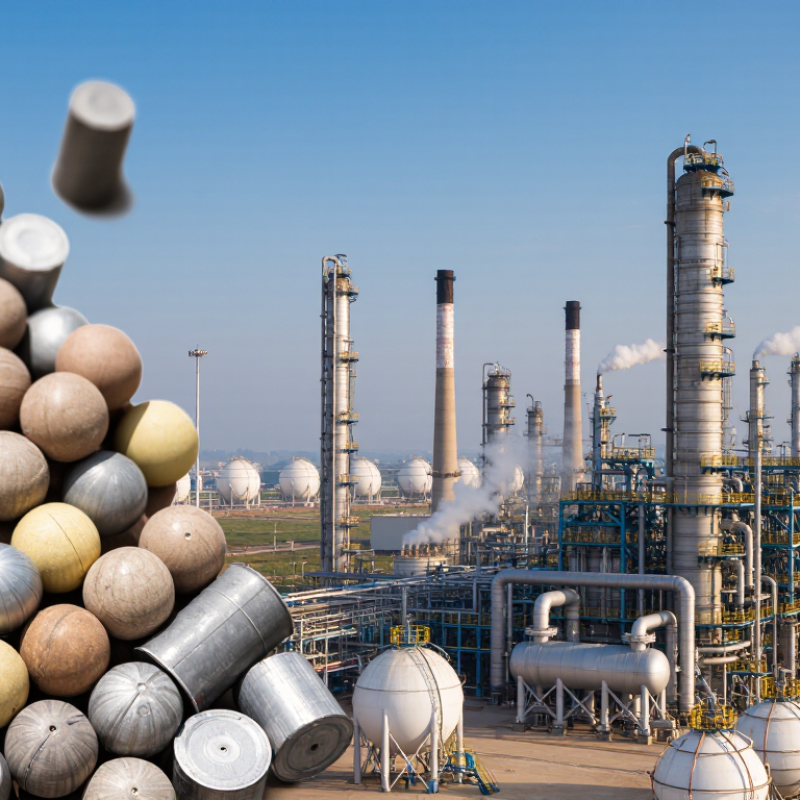
Choosing the right Petroleum Refining Catalysts can influence product quality, energy use, operating stability, and maintenance costs. Global buyers face different crude blends, refinery designs, fuel standards, and supply conditions. A catalyst performing well in a Gulf Coast fluid catalytic cracking unit may not deliver identical results in a European hydroprocessing system.
This guide examines ten widely used catalyst options across fluid catalytic cracking, hydrocracking, hydrotreating, catalytic reforming, and related processes. It considers activity, selectivity, regeneration behavior, resistance to contaminants, expected service life, and technical support. Practical details matter. A refinery manager may compare sulfur removal rates, while a procurement team checks delivery reliability, documentation, and compatibility with existing reactors.
No ranking is universal.
Catalyst selection requires verified operating data, laboratory testing, and consultation with qualified process engineers. Product sheets alone rarely show the full picture. Feedstock variability, reactor temperature, hydrogen availability, pressure, and catalyst loading can change performance significantly. This article therefore presents useful comparisons, not guaranteed outcomes. Some evaluations may remain imperfect because suppliers report performance under different conditions.
Reliable buyers should request safety data sheets, quality certificates, performance references, and clear replacement procedures. They should also confirm that products meet applicable environmental, transportation, and industrial regulations in each market. Cost should be measured against throughput, product yield, downtime risk, and disposal requirements—not only the purchase price.
The best choice is evidence-based. Careful validation protects both refinery performance and long-term investment.
10 Best Petroleum Refining Catalysts for Global Buyers
What Petroleum Refining Catalysts Are and Why They Matter
Petroleum refining catalysts are engineered materials that speed up chemical reactions without being consumed immediately. They help convert heavy hydrocarbons into cleaner, more useful fuels and chemical feedstocks. This is chemistry at scale.
Common refinery applications include fluid catalytic cracking, hydrotreating, and catalytic reforming. Each process requires a different catalyst structure and operating range. For example, hydrotreating catalysts help remove sulfur, nitrogen, and other impurities from refinery streams. This supports fuel quality and helps equipment meet emissions requirements.
Catalyst performance depends on feedstock composition, temperature, pressure, and reactor design. A material that performs well with light crude may struggle with heavy, metal-rich feedstock. Refinery engineers therefore examine activity, selectivity, stability, regeneration needs, and resistance to poisoning. Small changes in pore size can affect product yield. So can water content and operating discipline.
Not all performance claims tell the full story. Laboratory results may look strong, yet field conditions can be harsher. Catalyst deactivation may occur through coke formation, metal deposition, or thermal damage. Buyers should review independent test data, technical specifications, safety documentation, and lifecycle costs. Availability matters too, especially when replacement materials must cross borders quickly.
The best choice is rarely the cheapest option. It is the catalyst that fits the refinery’s actual process, feedstock, maintenance plan, and regulatory obligations. Even experienced teams can misjudge a catalyst during changing market conditions. That possibility deserves careful review.

Refinery catalysts are best classified by the process they support and the function they perform. Hydrotreating catalysts remove sulfur, nitrogen, and selected metals from feedstock. Their performance depends on hydrogen pressure, temperature, feed quality, and contaminant levels. Fluid catalytic cracking catalysts split heavy molecules into lighter products, such as gasoline-range compounds and olefins. Hydrocracking catalysts combine cracking with hydrogenation. They usually require careful control of acidity and metal activity.
Reforming catalysts rearrange hydrocarbon molecules and increase octane value. They also support hydrogen production within the refinery. Isomerization catalysts convert straight-chain molecules into branched structures, improving fuel performance without major boiling-range changes. Alkylation catalysts promote the formation of high-octane blending components. That process demands strict water and impurity control.
Function matters as much as process. A catalyst may provide hydrogenation, cracking, dehydrogenation, isomerization, or contaminant removal. Pore size, active metals, acidity, mechanical strength, and regeneration behavior shape its service life. Small details matter. A buyer should compare feedstock assays, reactor design, operating cycles, and expected catalyst replacement intervals. Laboratory data helps, but plant history often reveals more. Feedstock changes everything.
A clean product slate can hide higher pressure demand or faster deactivation. I have seen specifications look complete while missing metals exposure and shutdown conditions. That oversight can distort lifecycle cost. Global buyers should request test conditions, safety documentation, loading guidance, and measurable performance limits before approval.
| No. | Catalyst Type | Primary Refining Process | Typical Active Chemistry | Main Function | Typical Operating Window* | Key Feedstocks | Primary Product or Benefit | Important Selection Factors |
|---|---|---|---|---|---|---|---|---|
| 1 | Fluid Catalytic Cracking (FCC) Zeolite Catalyst | Fluid catalytic cracking | Y-type zeolite, usually stabilized or ultrastable, dispersed in a silica–alumina matrix | Cracks vacuum gas oil into lighter hydrocarbons through strong acid sites | Approximately 480–550 °C reactor temperature; near-atmospheric to moderately elevated pressure | Vacuum gas oil, heavy gas oil, and selected residue streams | High yields of gasoline-range hydrocarbons, LPG, and light olefins | Catalyst activity, bottoms conversion, coke selectivity, metals tolerance, attrition resistance, and zeolite-to-matrix balance |
| 2 | Cobalt–Molybdenum Hydrotreating Catalyst | Diesel and naphtha hydrotreating | Molybdenum sulfide promoted with cobalt on porous alumina | Hydrodesulfurization and moderate hydrodenitrogenation | Approximately 280–380 °C; commonly 20–80 bar hydrogen pressure | Straight-run naphtha, kerosene, diesel, and gas oils | Lower sulfur fuels and improved fuel stability | Sulfur and nitrogen level, feed boiling range, hydrogen consumption, pressure drop, and tolerance to contaminants |
| 3 | Nickel–Molybdenum Hydrotreating Catalyst | Hydrodesulfurization and hydrodenitrogenation | Molybdenum sulfide promoted with nickel on alumina or a silica–alumina support | Deep removal of sulfur and nitrogen; improved hydrogenation of aromatic compounds | Approximately 300–420 °C; commonly 30–130 bar hydrogen pressure | Heavy gas oil, coker gas oil, vacuum gas oil, and residue-derived feeds | Ultra-low-sulfur feed or product and reduced nitrogen inhibition in downstream units | Hydrogen partial pressure, aromatic saturation requirement, metals deposition, pore-size distribution, and catalyst cycle length |
| 4 | Nickel–Tungsten Hydrocracking Catalyst | Hydrocracking | Nickel–tungsten sulfide hydrogenation function combined with acidic zeolite or amorphous silica–alumina | Converts heavy molecules while simultaneously hydrogenating and removing heteroatoms | Approximately 350–430 °C; commonly 80–200 bar hydrogen pressure | Vacuum gas oil and hydrotreated heavy distillates | High-quality diesel, kerosene, naphtha, and lubricant-range products | Conversion target, product selectivity, hydrogen consumption, acidity, feed nitrogen, and resistance to deactivation |
| 5 | Platinum–Rhenium Reforming Catalyst | Catalytic reforming | Platinum and rhenium on chlorided alumina | Dehydrogenation, isomerization, and dehydrocyclization of naphthenes and paraffins | Approximately 450–540 °C; typically 5–35 bar hydrogen-containing process gas | Hydrotreated heavy naphtha | High-octane reformate and valuable hydrogen by-product | Chloride and moisture control, coke resistance, platinum dispersion, regeneration method, and reformate octane target |
| 6 | Isomerization Catalyst | Light naphtha isomerization | Platinum on chlorided alumina or platinum on sulfated zirconia | Rearranges normal pentane and hexane into branched isomers | Approximately 120–250 °C, depending on catalyst family; hydrogen is normally present | C5/C6 light naphtha with low sulfur and low water content | Higher octane without significant aromatic or olefin formation | Feed dryness, sulfur removal, benzene management, equilibrium limitations, and sensitivity to contaminants |
| 7 | Solid Acid Alkylation Catalyst | Isobutane–olefin alkylation | Strong solid acids such as ion-exchanged zeolites or supported superacid systems | Combines light olefins with isobutane to form branched paraffins | Generally low to moderate temperature; the exact window depends strongly on the solid-acid technology | Propylene, butylenes, amylenes, and isobutane | Low-sulfur, low-olefin, high-octane alkylate blending component | Acid strength, catalyst regeneration, water tolerance, olefin-to-isobutane ratio, corrosion control, and product selectivity |
| 8 | Residue Hydroprocessing Catalyst | Fixed-bed, moving-bed, or ebullated-bed residue upgrading | Nickel–molybdenum or nickel–tungsten sulfides on graded porous supports | Removes sulfur, nitrogen, metals, and Conradson carbon while increasing hydrogen content | Approximately 350–450 °C; commonly 100–200 bar hydrogen pressure | Atmospheric residue, vacuum residue, and deasphalted oil | Cleaner refinery feed, reduced fuel-oil sulfur, and improved downstream conversion | Vanadium and nickel tolerance, pore-mouth plugging, metals capacity, guard-bed design, and replacement frequency |
| 9 | Selective Hydrogenation Catalyst | Naphtha, pygas, or FCC gasoline hydrogenation | Palladium, nickel, or supported noble-metal formulations selected for controlled hydrogenation | Saturates unstable diolefins and acetylenes while limiting excessive olefin conversion | Approximately 40–220 °C, depending on feed and target reaction; low to moderate hydrogen pressure | Pyrolysis gasoline, FCC gasoline, and olefin-rich refinery streams | Improved product stability, reduced gum formation, and controlled sulfur or olefin management | Selectivity, feed contaminants, temperature rise, hydrogen-to-feed ratio, pressure drop, and protection against over-hydrogenation |
| 10 | Claus Sulfur-Recovery Catalyst | Sulfur recovery from acid gas | High-surface-area activated alumina, often supplemented with titania for enhanced hydrolysis or sulfur conversion | Promotes conversion of hydrogen sulfide and sulfur dioxide into elemental sulfur | Approximately 200–350 °C in catalytic Claus converters | Amine-acid gas and sour-water-stripper gas containing hydrogen sulfide | Higher sulfur recovery, lower sulfur emissions, and improved compliance with environmental limits | Thermal stability, water and hydrocarbon tolerance, COS/CS2 hydrolysis activity, fouling resistance, and pressure drop |
*Operating windows are representative industry ranges rather than guaranteed design specifications. Actual conditions depend on feed composition, reactor configuration, hydrogen availability, product targets, catalyst formulation, and refinery operating strategy.
For global buyers, the ten leading petroleum refining catalysts are not ranked by price alone. Selection should match feedstock, unit design, emissions limits, and campaign length. In practical evaluations, FCC zeolite catalysts remain central for converting vacuum gas oil into gasoline and light olefins. Hydrocracking catalysts combine acidic supports with nickel-molybdenum or noble-metal functions. They favor cleaner middle distillates when hydrogen pressure and feed quality are suitable. Hydrotreating catalysts based on cobalt-molybdenum or nickel-molybdenum remove sulfur and nitrogen before sensitive downstream units. They need controlled activation and careful temperature management.
Platforming reforming catalysts typically use platinum on alumina, sometimes with a second metal for stability. They raise octane and produce hydrogen, but feed contaminants can quickly reduce activity. Isomerization catalysts, including chlorided alumina and zeolitic systems, improve light gasoline quality under different moisture tolerances. Alkylation catalysts may use solid acids, offering handling advantages over liquid-acid approaches. The chemistry looks simple. Operations are not.
Sulfur-recovery catalysts commonly use activated alumina or titania to support Claus conversion. Selective hydrogenation catalysts protect product specifications and downstream equipment. Demetallization catalysts target nickel and vanadium in heavier feeds. Residue hydroconversion catalysts handle asphaltenes, metals, and severe operating conditions. Buyers should request activity data, crush strength, pore distribution, regeneration limits, and contaminant tolerance. Ask for independent test methods. One weakness remains: laboratory results can overstate refinery performance. Pilot trials, loading records, and realistic feed samples reveal more. Small details matter.
Ten leading petroleum refining catalyst families ranked by representative operating temperature
The chart compares typical reactor temperatures used by major petroleum-refining catalyst families. Values are representative industry conditions and may vary with feedstock, pressure, catalyst formulation, and process design. Lower-temperature processes generally require more active or highly selective catalyst systems, while high-temperature processes are commonly used for hydrogen production and hydrocarbon conversion.
Choosing among the 10 best petroleum refining catalysts requires more than comparing quoted prices. Performance should be measured against the actual feedstock, operating temperature, pressure, and contaminant profile. Activity matters, but selectivity often matters more. A catalyst that produces higher conversion can still lose value through unwanted by-products. Review pilot data, commercial references, and results from feeds similar to yours.
Cost should be calculated per barrel processed, not per kilogram purchased. Include loading, activation, regeneration, energy use, replacement frequency, and spent-material handling. A lower upfront price may become expensive if pressure drop increases quickly. Ask suppliers for cycle-length data under realistic conditions. Laboratory results are useful, but they rarely show every operating challenge.
Reliability depends on stable supply, consistent specifications, technical support, and predictable performance between batches. Request certificates, quality-control records, and clear delivery schedules. During trials, track yield, temperature changes, pressure drop, and deactivation rate. Keep the test design transparent. No scorecard is perfect. In practice, operators sometimes weight initial activity too heavily and overlook maintenance delays. A slightly less active catalyst may deliver better annual economics when it runs steadily, protects equipment, and requires fewer unplanned changes. Review the decision with process engineers, operators, and procurement staff before committing to a long-term supply agreement.
Global refining capacity reached about 103.9 million barrels per day in 2023, according to OPEC’s 2024 Annual Statistical Bulletin. This scale makes catalyst selection a commercial decision, not only a technical one. Buyers should match catalyst activity with feedstock sulfur, nitrogen, metals, and aromatics. A high-activity catalyst may perform poorly when metals quickly block its pores. Feed analysis must come before supplier comparisons.
Start with operating evidence from a similar refinery configuration. Review conversion, product quality, pressure drop, cycle length, and regeneration behavior. The IEA’s Oil 2024 report warns that refining capacity growth may outpace demand growth this decade. Margin pressure could therefore make small yield losses expensive. Ask for independent test data, not only laboratory claims. Plant references matter.
Supply reliability also deserves attention. Check manufacturing capacity, inspection procedures, storage limits, transport risks, and technical support near the operating site. Confirm how the catalyst handles temperature changes and unexpected feed variation. It may not. This is where many purchasing models become too optimistic. A spreadsheet can miss emergency inventory costs, delayed shipments, or a difficult catalyst changeout. Buyers should also verify waste handling requirements and local environmental rules before signing a long-term agreement.
